Butterflies and Insects of Madagascar
Madagascar holds an estimated 100,000 invertebrate species with the overwhelming majority endemic, and two of them are worth planning a walk around. The comet moth has a wingspan reaching 20 centimetres with tails adding another 15, and the giraffe-necked weevil rolls leaves into egg tubes using a neck two to three times longer in males than females. Ranomafana and Andasibe are where both are found.
The Comet Moth
Argema mittrei, the comet moth or Madagascan moon moth, is among the largest lepidopterans in the world. Only the Atlas moth of Asia, in the same emperor moth family, rivals it.
The wingspan reaches around 20 centimetres with trailing tails adding roughly another 15, in pale yellow marked with eyespots. It is a spectacular animal by any measure.
The adult life is four or five days and is devoted entirely to reproduction. The proboscis is atrophied and the moth cannot feed, so everything depends on reserves built during the caterpillar stage.
Larvae spend around two months feeding before spinning a cocoon, and the metamorphosis takes a further two to six months.
Being nocturnal, it is seen at lights around lodges or in the early morning before it settles. Guides at the eastern rainforest parks know where they occur.
The comet moth cannot eat. It has four or five days as an adult, no working mouthparts, and everything it does in that time runs on what the caterpillar stored.
The Giraffe-Necked Weevil
Trachelophorus giraffa is the insect that appears on most Madagascar wildlife lists, black-bodied with bright red elytra covering the wings and a neck that gives it the name.
Males carry necks two to three times the length of females. Total body length runs to around 25 millimetres, which makes it the largest of the leaf-rolling weevils while being small in absolute terms.
The neck serves several purposes: combat between males over females, attracting mates, and nest building. Watching a male roll a leaf into a neat protective tube around a single egg is the behaviour worth waiting for.
It is diurnal, which makes it findable on a normal park walk rather than requiring a night circuit, though locating one needs a guide who knows the host trees.
A smaller relative, Trachelophorus madegassus, occurs in the rainforest at Ranomafana and parts of the highlands.
The species was described in 1860 and is listed as near threatened.
Butterflies
Madagascar records around 297 butterfly species with 210 of them endemic, and most are diurnal, which makes them easier to work with than much of the island’s wildlife.
The Madagascar diadem or gladiator butterfly, Hypolimnas dexithea, is the one collectors have long sought, notably large and boldly marked.
The sunset moth, Chrysiridia rhipheus, is often mistaken for a butterfly since it flies by day. Its iridescent wings are structurally coloured rather than pigmented, and it is frequently described as among the most beautiful lepidopterans anywhere.
Widespread African species also occur, including the African monarch, small grass yellow and several blues, which turn up alongside the endemics.
Around 268 moth species are recorded, mostly nocturnal, of which the comet moth is the headline.
Where to look. Ranomafana for consistent giraffe weevil sightings and the smaller relative, Andasibe-Mantadia for both weevil and comet moth, Marojejy for the weevil in less visited forest.
When to look. The warmer wetter months from September to May for the weevil, which is most active then. Comet moths emerge seasonally and guides at the eastern lodges know when. Insects as a whole follow the reptile pattern.
Other Insects Worth Finding
Beyond the two headliners, several groups reward attention on a forest walk.
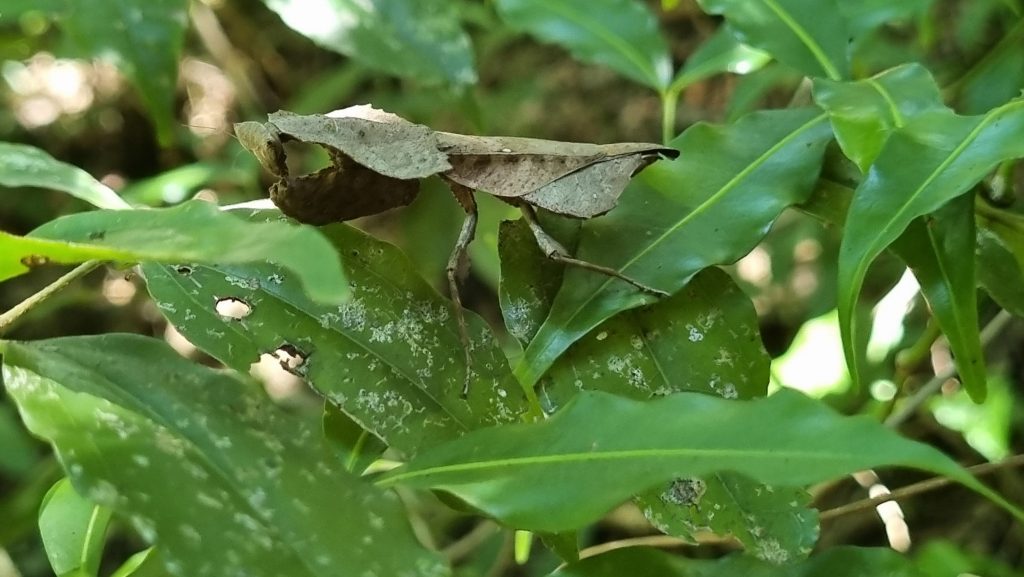
Stick insects are the camouflage specialists. Achrioptera impennis looks precisely like a dry branch, and the pink-winged Sipyloidea sipylus sprays a harmless defensive secretion when handled.
Praying mantises occur throughout, and the flatid leaf bug produces nymphs that cluster on stems in white waxy filaments, which is one of the more photographed insect sights in Madagascar.
The Madagascar hissing cockroach is large, harmless and produces the sound that gives it the name by forcing air through spiracles. It turns up in leaf litter on night walks.
Fire millipedes in bright orange and black are common on rainforest floors, and the rainbow milkweed locust is boldly coloured as a warning.
Termites are the unglamorous engineers, breaking down dead plant material and building mounds in the dry forests that can exceed three metres, creating microhabitat for other species.
Spiders and Other Invertebrates
Most Malagasy spiders are endemic, and the group is under-studied compared with the vertebrates.
Golden orb weavers build large webs across forest paths, and the silk of one Malagasy species has been worked into textiles in projects that attracted attention some years ago.
Wolf spiders hunt at ground level and are nocturnal, turning up in torchlight on night walks alongside the chameleons and geckos.
None of Madagascar’s spiders presents a serious threat to people, in keeping with the pattern across the island’s fauna.
Freshwater and marine invertebrates fill out the picture, with crabs in the mangrove systems at Kirindy Mite and Honko, and the reef invertebrates at Tanikely and the Masoala reserves.
Finding the giraffe weevil takes a guide who knows the host trees rather than general searching, and the same applies to most of the insect list. Mentioning insects on the first morning rather than the last changes what a guide looks for, and at Ranomafana and Andasibe there are guides with a specific interest who will find things others walk past.
Photographing Insects
Insects are the strongest argument for bringing a macro lens to Madagascar, and much of what makes the island unusual is small.
The giraffe weevil at 25 millimetres, leaf-tailed geckos, mantella frogs and the Brookesia chameleons all reward close work, and none of them requires the long lens that lemurs demand.
Light is the difficulty in rainforest. A macro flash or diffused fill helps considerably, though it should be used sparingly around any animal and not repeatedly on one individual.
Night walks turn up a different cast entirely, with sleeping insects and the nocturnal species easier to get close to than by day.
Humidity between 90 and 97 percent in the eastern forests means dry bags and silica gel matter more than an extra lens.
Insects and the Wider Ecosystem
Invertebrates do the work that keeps Madagascar’s forests functioning, and the scale of that role is easy to miss alongside the lemurs.
Pollination, decomposition and nutrient cycling all run on insects. Termites in the dry forests break down dead plant material and build mound systems that influence water retention and soil aeration, creating microhabitat for other species.
Several plant and animal relationships here are specific rather than general. Darwin’s orchid, Angraecum sesquipedale, has a nectar spur around thirty centimetres long and is pollinated by a moth with a proboscis to match, a pairing Darwin predicted before the moth was found.
Golden mantella frogs and other mantellas acquire their skin toxins from a diet of ants and mites, which means the frogs depend directly on the invertebrate community around them.
Forest clearance affects invertebrates faster than vertebrates, since many species have ranges limited to single forest patches and are lost before they are described.
Best Time to Look
Insects follow the same seasonal pattern as reptiles and amphibians, which is to say the warm wet months.
September to May. The giraffe weevil is most active across this long window, which covers the warmer wetter months. The best period for insects as a whole in the eastern rainforest.
November to March. Peak activity for most groups, with the forest at its wettest and warmest. Night walks are loud with insects and frogs. The trade-off is rain, mud and cyclone risk on the east.
April to June. Rains easing with insects still active and trails improving. Fewer visitors at the eastern parks. A reasonable compromise window.
June to August. Cool and dry, when many insects become inactive or hidden as reptiles do. The weakest window for invertebrates even though it suits road travel and trekking best.
Frequently Asked Questions
How many insect species does Madagascar have?
Estimates put invertebrates at around 100,000 species with the overwhelming majority endemic, and new species are described regularly. Butterflies number around 297 with 210 endemic, alongside roughly 268 recorded moth species. Beetles and moths are the groups with thousands of species each.
Where can I see the giraffe-necked weevil?
Ranomafana offers consistent sightings and is the usual recommendation, with Andasibe-Mantadia and Marojejy also holding them. They are diurnal so no night walk is needed, but finding one requires a guide who knows the host trees. Most active in the warmer wetter months from September to May.
How big is the comet moth?
The wingspan reaches around 20 centimetres with trailing tails adding roughly another 15, making it among the largest lepidopterans in the world. Only the Atlas moth of Asia, in the same emperor moth family, rivals it. Adults live four or five days and cannot feed, since the proboscis is atrophied.
Are any insects dangerous?
Nothing presents a serious threat. Malagasy spiders are almost all endemic and none is dangerous to people, in keeping with the wider pattern across the island’s fauna. The main insect concern is mosquitoes, since malaria is present across the country outside Antananarivo, so repellent and long sleeves after dark matter.
When is the best time for insects?
September to May for the giraffe weevil, with November to March the peak for most groups when the forest is warmest and wettest. June to August sees many insects inactive or hidden as reptiles are, which makes it the weakest window even though it suits trekking and road travel best.
Do I need a macro lens?
It is the underrated choice for Madagascar. The giraffe weevil at 25 millimetres, leaf-tailed geckos, mantella frogs and Brookesia chameleons all reward close work and none needs the long lens that lemurs demand. Light is the difficulty in rainforest, so diffused fill helps.
What is the sunset moth?
Chrysiridia rhipheus, a day-flying moth often mistaken for a butterfly, with iridescent wings that are structurally coloured rather than pigmented. It is frequently described as among the most beautiful lepidopterans anywhere and is endemic to Madagascar.
Can I collect or export insects?
No. Exporting wildlife or wildlife products from Madagascar requires permits and most is prohibited outright. The giraffe weevil is listed as near threatened, and collection pressure affects several showy species. Photograph and leave, and do not buy mounted specimens from vendors.
Planning Your Trip
Madagascar’s insects are the part of its wildlife that most visitors walk past, and the fix costs nothing: say on the first morning that they interest you. The giraffe weevil rolling a leaf and a comet moth at a lodge light are both memorable, and both depend on a guide knowing you care.
Booking Your Madagascar Trip
The safari companies and tour operators listed on this website put trips like this together for a living and know which camps, guides and routes actually deliver. We are an independent guide to Madagascar; we do not book or sell tours ourselves.
When you are ready, arrange your safari, tour or holiday with one of the recognised operators listed here. Tell them your dates and what matters most, and a real person, not a form, will handle the itinerary, park bookings and logistics for you.