Central Highlands of Madagascar
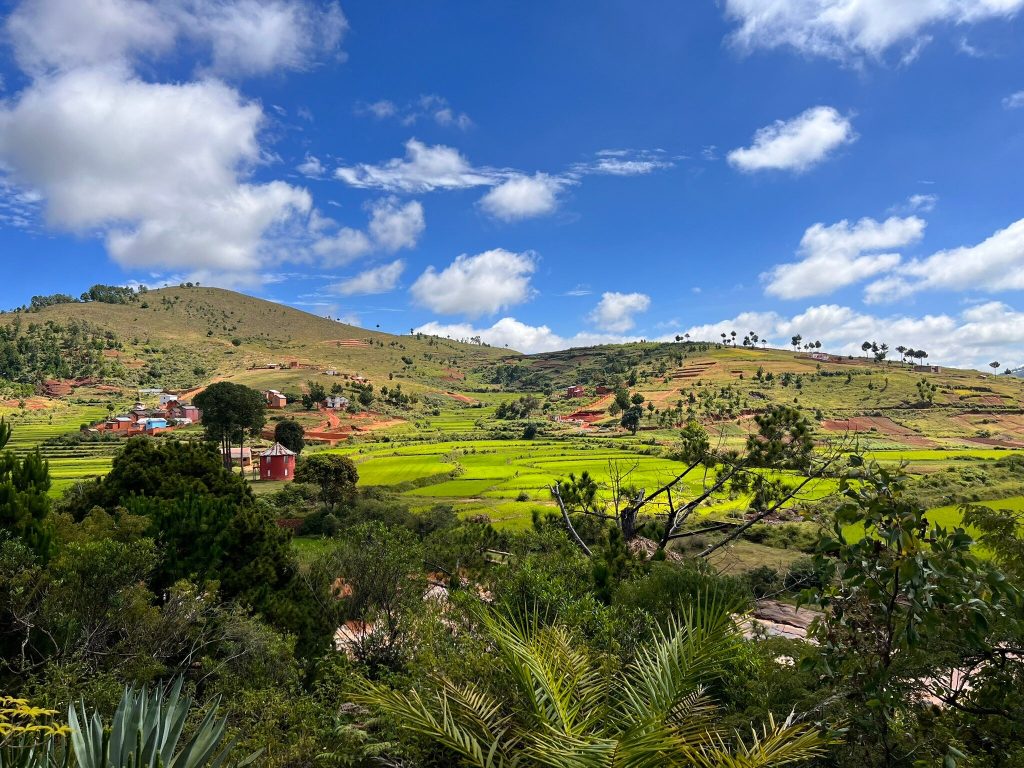
The Central Highlands are where most trips to Madagascar begin and where nearly all of them pass through, a plateau of terraced rice fields and red-earth villages running from Antananarivo south through Antsirabe and Fianarantsoa. This is the country’s cultural core rather than its wildlife heartland, and it is considerably colder than visitors expect.
What the Highlands Are and Why They Matter
The plateau runs down the spine of Madagascar at altitudes between roughly 800 and 1,800 metres, and it is where the majority of the population lives. Antananarivo sits at 1,280 metres, Antsirabe at 1,500, and the mountains at Andringitra rise well above both.
What defines the region visually is rice. Terraced paddies climb every available slope, worked by hand, changing colour through the year from flooded silver to green to gold. The red laterite soil beneath gives the highlands their other signature, visible in the earth-brick houses that cluster on hilltops.
Almost no original forest survives here. Centuries of clearance for rice and pasture have left grassland and eucalyptus across most of the plateau, which is why the highlands hold few parks and why wildlife travellers pass through rather than stopping.
Terraced rice, red earth and hilltop villages. The highlands are Madagascar’s cultural centre and the region where the forest has already gone.
Antananarivo and the Merina Heartland
Antananarivo is built across twelve hills and is the hub for every domestic flight and every road route in the country. Most visitors treat it as an obstacle between the airport and the parks, which is understandable and slightly unfair.
The Rova palace complex on Analamanga hill was the seat of the Merina monarchy that unified much of Madagascar in the nineteenth century before French colonisation in 1895. An arson attack in 1995 gutted it and reconstruction has run since. The view from the top covers the whole city.
Analakely market is the strongest experience the capital offers, dense with pink rice, dried fish, spices and the working trade of a city rather than anything arranged for visitors. The Haute-Ville below the Rova holds colonial villas on steep cobbled streets.
Ambohimanga, 20 km north, is the royal hill where the Merina kingdom began and is a UNESCO World Heritage Site in its own right. Better preserved than the fire-damaged Rova, it gives a clearer picture of the kingdom before French rule and takes half a day.
Antsirabe and the Spa Town Country
Antsirabe is the standard first overnight heading south, three to four hours from the capital, and the most distinctive town on the RN7.

The French built it as a hill station and spa around thermal springs, earning it the nickname the Vichy of Madagascar. Wide colonial avenues, Art Deco shopfronts and a cathedral built by Norwegian missionaries make an architectural mix that exists nowhere else in Madagascar.
Several thousand hand-pulled pousse-pousse rickshaws work the streets, more than anywhere else in the country, and hiring one is how visitors see the town. Artisan workshops turn zebu horn into cutlery and recycled tin into miniature bicycles.
Lake Tritriva, 17 km west, is a collapsed volcanic crater holding deep green water ringed by cliffs, with a local legend of two lovers attached to it. Lake Andraikiba closer to town is larger and gentler.
Fianarantsoa, Ambalavao and the Betsileo
Fianarantsoa holds the best-preserved historic quarter in Madagascar. Where Antananarivo’s old city has been heavily altered, the Haute-Ville here retains its nineteenth-century street layout, red-brick houses and stone churches largely intact.
The town is the centre of the Betsileo, the highland people known for terraced rice cultivation and for famadihana, the turning of the bones, in which ancestors are exhumed, rewrapped and celebrated. It is often called the intellectual capital of Madagascar for its universities and seminaries.
Nearby sit two unlikely industries. The Sahambavy tea estate is Madagascar’s only commercial tea plantation, nearly 400 hectares wrapped around a lake. The surrounding hills produce the country’s small wine industry, an inheritance from French colonial agriculture, more interesting than good.
Ambalavao further south makes Antemoro paper by a method brought from the Arab world centuries ago, and hosts the largest zebu market in Madagascar on Wednesdays and Thursdays.
Passing through. One night at Antsirabe on the way south, a day in Antananarivo at either end of the trip. What most itineraries allow and enough to see the towns.
Taking the highlands seriously. Two nights at Antsirabe for the crater lakes and workshops, two at Fianarantsoa for the old town and tea estate, plus Ambohimanga from the capital. Adds three or four days.

Wildlife in the Highlands
The highlands are the weakest region in Madagascar for wildlife, and it is worth saying so plainly. Centuries of forest clearance have left little habitat, and travellers wanting lemurs go east or south.
Two exceptions are worth knowing. Anja Community Reserve at the southern edge near Ambalavao holds the densest ring-tailed lemur population in the country, in a patch of forest beneath granite domes, entirely village-owned and run. It takes ninety minutes and sits directly on the RN7.
Andringitra National Park reached from Ambalavao is the highland exception at scale, holding Pic Boby at 2,658 metres, ring-tailed lemurs living above the treeline at 2,520 metres, and plant communities with more in common with African mountains than with the rest of Madagascar.
Ambohitantely Special Reserve northwest of the capital protects one of the last remaining patches of highland forest, a fragment of what once covered the plateau, and is visited mainly by researchers.
Highland Culture, Tombs and Famadihana
The highlands hold Madagascar’s most visible ancestral traditions. Family tombs are built of stone and stand prominently in the fields, often more substantial than the houses of the living.
Famadihana, the turning of the bones, is the practice that draws most attention. Every few years a family exhumes ancestors, rewraps them in fresh silk shrouds, and celebrates with music, dancing and feasting before returning them. It happens in the dry season between roughly June and September.
Visitors are occasionally invited but should never expect or request attendance. These are family occasions with genuine emotional weight, and turning up as a spectator is not appropriate.
The Merina and Betsileo are the two highland peoples, historically rice farmers and, in the Merina case, the builders of the kingdom that dominated much of the island before colonisation. Fady, the system of local taboos, is strong here as elsewhere and guides will brief visitors where it matters.
The highlands are genuinely cold and travellers arriving from the coast are consistently caught out. At Antsirabe and Fianarantsoa nights drop close to freezing from June to August, and hotels rarely have heating. The Andringitra plateau records the lowest temperatures in Madagascar with frost on the ground. Pack a fleece, a hat and warm layers for any highland travel, and a proper sleeping bag if camping.
Travelling Through the Highlands
The RN7 runs the length of the plateau and is sealed throughout, which makes this the easiest region to travel in Madagascar. Antananarivo to Antsirabe takes three to four hours, Antsirabe to Fianarantsoa most of a day with stops.
Taxi-brousse services are frequent on this corridor and are how most Malagasy people travel. Independent travel here is straightforward, with guesthouses in every town and few of the logistical problems that make the west and northeast difficult.
The FCE railway from Fianarantsoa descends 163 km to Manakara on the coast through 48 tunnels and 67 bridges, taking anywhere from twelve to twenty-four hours. It is an experience rather than transport, and nobody with a flight to catch within two days should attempt it.
Best Time to Visit the Central Highlands
The highland climate is temperate year-round and considerably cooler than the coasts, which is precisely why the French built their spa town here.
April to June. Rains ending, clear air, green countryside and comfortable walking. Among the pleasantest months on the plateau and good for the crater lakes and rice terrace walks.
July and August. Coldest and driest, with mornings that bite and nights close to freezing. Dry and clear, and the peak RN7 season. Famadihana ceremonies take place in this window. Pack proper layers.
September to November. Warming, jacarandas flowering around Lac Anosy in October, countryside at harvest. Reliable roads and the busiest period for travel south. A strong all-round window.
December to March. Wet season with heavy afternoon rain and occasional flooding in low-lying districts of the capital. Roads deteriorate and the FCE becomes even less reliable. Quieter and cheaper.
Frequently Asked Questions
Are the highlands worth stopping in?
For culture and architecture, yes. Fianarantsoa has the best-preserved old town in Madagascar, Antsirabe the most distinctive townscape, and Ambohimanga is a UNESCO site giving a clear picture of the Merina kingdom. For wildlife, no, apart from Anja and Andringitra at the southern edge. Most itineraries pass through rather than lingering.
How cold does it get?
Colder than most visitors expect. Nights at Antsirabe and Fianarantsoa drop close to freezing from June to August, and hotels rarely have heating. Andringitra records the lowest temperatures in Madagascar, with frost normal on the plateau. Travellers arriving from Nosy Be or the coast routinely underestimate this.
How long should I spend in Antananarivo?
One night is what most itineraries allow and is enough if the city is a transit point. Two nights lets you see the Rova, the Haute-Ville and Analakely market properly, plus a half day at Ambohimanga. Few travellers plan more, and the city works better as bookends than as a destination.
Can I see lemurs in the highlands?
At Anja Community Reserve near Ambalavao, which holds the densest ring-tailed lemur population in Madagascar and takes ninety minutes directly off the RN7. Andringitra has ring-tails living above the treeline. Elsewhere on the plateau the forest has gone and with it the wildlife. Lemurs’ Park near the capital holds a captive collection.
What does highland travel cost?
The cheapest region in Madagascar. Hotels in Antsirabe and Fianarantsoa are inexpensive and rarely need booking far ahead outside July to October. A pousse-pousse tour costs around 10 US dollars, Lake Tritriva entry about 3 with transport at 15 to 25 return. Taxi-brousse fares on the RN7 are minimal.
Can I attend a famadihana?
Only if invited, and it should never be requested. The turning of the bones is a family occasion with real emotional significance, held in the dry season between roughly June and September. Turning up as a spectator is inappropriate. Guides will explain the practice, and that is the right way to learn about it.
Is the FCE railway worth taking?
If you have time and tolerance for uncertainty. The descent from Fianarantsoa to Manakara through rainforest, with village stations where whole communities turn out to trade, is memorable. Delays of many hours are normal and breakdowns happen. Twelve hours is the estimate and twenty is common.
What should I buy in the highlands?
Zebu horn crafts, semi-precious stones, embroidery and the miniature vehicles made from recycled tin at Antsirabe, where prices are lower than Antananarivo and much lower than the coast. Antemoro paper at Ambalavao. Vanilla and spices at Analakely, considerably cheaper than at the airport.
Planning Your Trip
The highlands are the part of Madagascar most travellers see the most of and pay the least attention to. Building in one extra night at Antsirabe or Fianarantsoa turns a series of driving stops into a region with genuine character, and it costs very little.
Booking Your Madagascar Trip
The safari companies and tour operators listed on this website put trips like this together for a living and know which camps, guides and routes actually deliver. We are an independent guide to Madagascar; we do not book or sell tours ourselves.
When you are ready, arrange your safari, tour or holiday with one of the recognised operators listed here. Tell them your dates and what matters most, and a real person, not a form, will handle the itinerary, park bookings and logistics for you.